
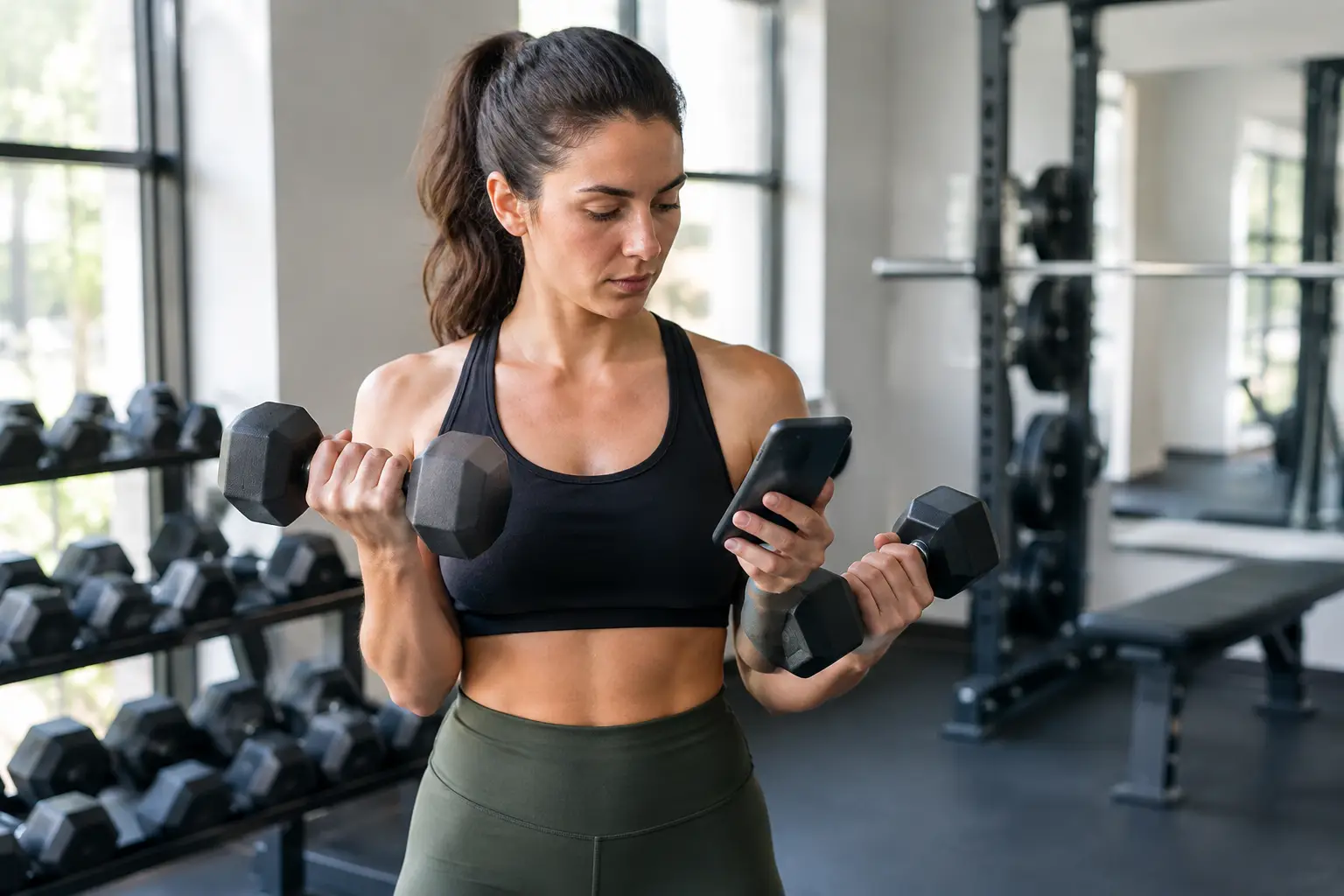
You finish a set of dumbbell rows with a 30-pound dumbbell and then wonder what to write down: 30 pounds total, 60 pounds total, or something else? Learning how to track dumbbell weights per hand removes that small bit of confusion. More importantly, it gives you workout notes you can actually use the next time you train.
The simple rule is this: log the weight of the dumbbell in one hand, unless your workout app or program clearly asks for total load. If you used two 20-pound dumbbells for a press, record 20 pounds. If you used one 35-pound dumbbell for a one-arm row, record 35 pounds.
That convention keeps your records consistent. Consistency matters more than finding the one perfect way to write every lift.
What “per hand” means with dumbbells
Dumbbells are almost always labeled by the weight of one dumbbell. A 15-pound dumbbell weighs 15 pounds, whether you hold one or hold two. So when you do a dumbbell bench press with two 15-pound dumbbells, the working weight is usually logged as 15 pounds per hand.
This is different from a barbell, where the number you record normally represents the full load on the bar. It is also different from some cable machines, where the displayed number may not reflect the exact resistance you feel. Dumbbells are more straightforward, as long as you do not switch between per-hand and total-pair logging halfway through your training history.
For most people, recording per hand is the clearer choice. When you return after a busy month, you can see immediately whether you pressed 20s, 25s, or 30s. You do not have to divide an old number in half before you start.
How to track dumbbell weights per hand in your workout log
Use one format repeatedly: weight per hand x reps x sets. For example, a dumbbell shoulder press might read:
25 lb per hand x 8 reps x 3 sets
You do not need to write “per hand” on every entry if your log is already set up for dumbbells. But add it in your notes at first if it helps establish the habit. The goal is for future you to understand the entry in two seconds.
For a set where your reps change, record each set separately. That could look like 25 pounds per hand for 10, 9, and 8 reps. Those details are useful because they show what happened, not what you hoped would happen.
If your gym only has kilograms, keep using kilograms in your log. If the handles are marked in pounds, use pounds. Switching units creates needless friction, especially when training already has to fit around work, kids, travel, or a week with poor sleep.
Bilateral dumbbell exercises
Bilateral means both sides work at the same time. Common examples include dumbbell bench presses, goblet squats, Romanian deadlifts, and standing shoulder presses.
With a bilateral exercise, log the weight of one dumbbell when you use a pair. Two 25-pound dumbbells are recorded as 25 pounds per hand, not 50 pounds. A goblet squat is the exception in practice because you hold one dumbbell with both hands. If you hold one 40-pound dumbbell, log 40 pounds.
The movement matters more than the number of hands touching the weight. Record the actual dumbbell you used.
Unilateral dumbbell exercises
Unilateral means you train one side at a time. Think one-arm rows, split squats, suitcase carries, or single-arm presses.
For these, record the dumbbell weight and the reps completed on each side. A clear entry might be: 35 lb x 10 reps each side x 3 sets.
If both sides complete the same reps with the same weight, “each side” is enough. If they differ, write down the difference. For example: 35 pounds for 10 reps on the right and 8 reps on the left. That is not a failed workout. It is simply useful context for next time.
Start with the side that feels less steady or less practiced, then match that number of reps on the other side. This makes your log easier to interpret and keeps one side from quietly doing much more work every session.
Do not double the weight unless you mean total load
You may see people describe a dumbbell press using the combined load: two 30-pound dumbbells equals 60 pounds total. That math is not wrong. It is just a different tracking system.
Total load can be useful when comparing the overall external load of certain exercises. But it can also make records harder to read. “60-pound dumbbell press” may sound like one 60-pound dumbbell, a 60-pound total pair, or a different setup entirely.
For your own workout history, per-hand logging usually wins because it mirrors the equipment rack. You picked up the 30s. Write down the 30s.
If you already have months of entries logged as total pair weight, you do not need to rewrite everything. Make a note of the old convention, then choose one method going forward. A clean restart is often more useful than perfect historical data.
Track the details that change the meaning of the weight
The dumbbell number alone does not tell the whole story. Twenty pounds can feel very different depending on the exercise, the number of reps, your range of motion, and how much rest you took.
Keep the basic record simple, then add a short note when it will help you make a better decision later. You might note that you used an incline bench, paused at the bottom, performed alternating reps, or stopped a set because your form became shaky. These are meaningful changes, not excuses.
You also do not need to treat every workout like a test. If you used lighter dumbbells because time was short, you were returning after a break, or the gym was crowded, log what you did. A real entry from a shorter session is more helpful than an imaginary ideal session that never happened.
Use small progress markers, not just heavier dumbbells
The next pair of dumbbells is not always available, and it may be a bigger jump than you are ready for. Progress can show up in other ways.
You may complete one more rep with the same weight. You may do the same reps with steadier control. You may complete all planned sets instead of fading after the first one. You may need less time to remember where you left off.
These are worth tracking because they help you see a trend without forcing a bigger number every session. If you pressed 20 pounds per hand for three sets of eight last week and three sets of ten this week, your log has done its job.
When a weight, rep range, and setup feel repeatable, consider a small change next time. That might mean an extra rep, another set if it fits your plan, or the next available dumbbell. It depends on the exercise and how your recent training has felt. There is no need to rush a jump just to make the log look impressive.
Adjustable dumbbells need one extra note
Adjustable dumbbells are convenient, but they can make old workout records slightly harder to decode. Some sets change in 2.5-pound steps, while others jump by 5 pounds or more. The handle weight may also be included differently depending on the set.
Log the displayed or selected weight as your equipment defines it. Then keep using that same measurement. If your adjustable dumbbell says 22.5 pounds, record 22.5 pounds per hand. Avoid trying to estimate the plates separately unless that is how you consistently set up the equipment.
A short note such as “adjustable pair” can help if you train sometimes at home and sometimes at a gym. The same number can feel different across handles, grips, and equipment, so compare like with like when you can.
Let your log make the next workout easier
A useful workout log answers a few practical questions: What dumbbell did I use? How many reps did I get? Did both sides feel similar? What should I try today?
Corely can keep those details beside the rest of your training week, but the tool matters less than the habit. Use an app, a notes file, or a small notebook. Pick the option you will still use when life is busy.
Your log does not need to prove anything. It only needs to leave a clear enough trail for your next session. Write down the dumbbell in one hand, the reps you completed, and one note when it matters. Then let that be enough to help you show up again.